
How We Make Our Bleach Dyed T-Shirts
The Process Behind Every One of One Design
Every shirt we make is different. That's not a marketing line, it's just the truth about bleach.
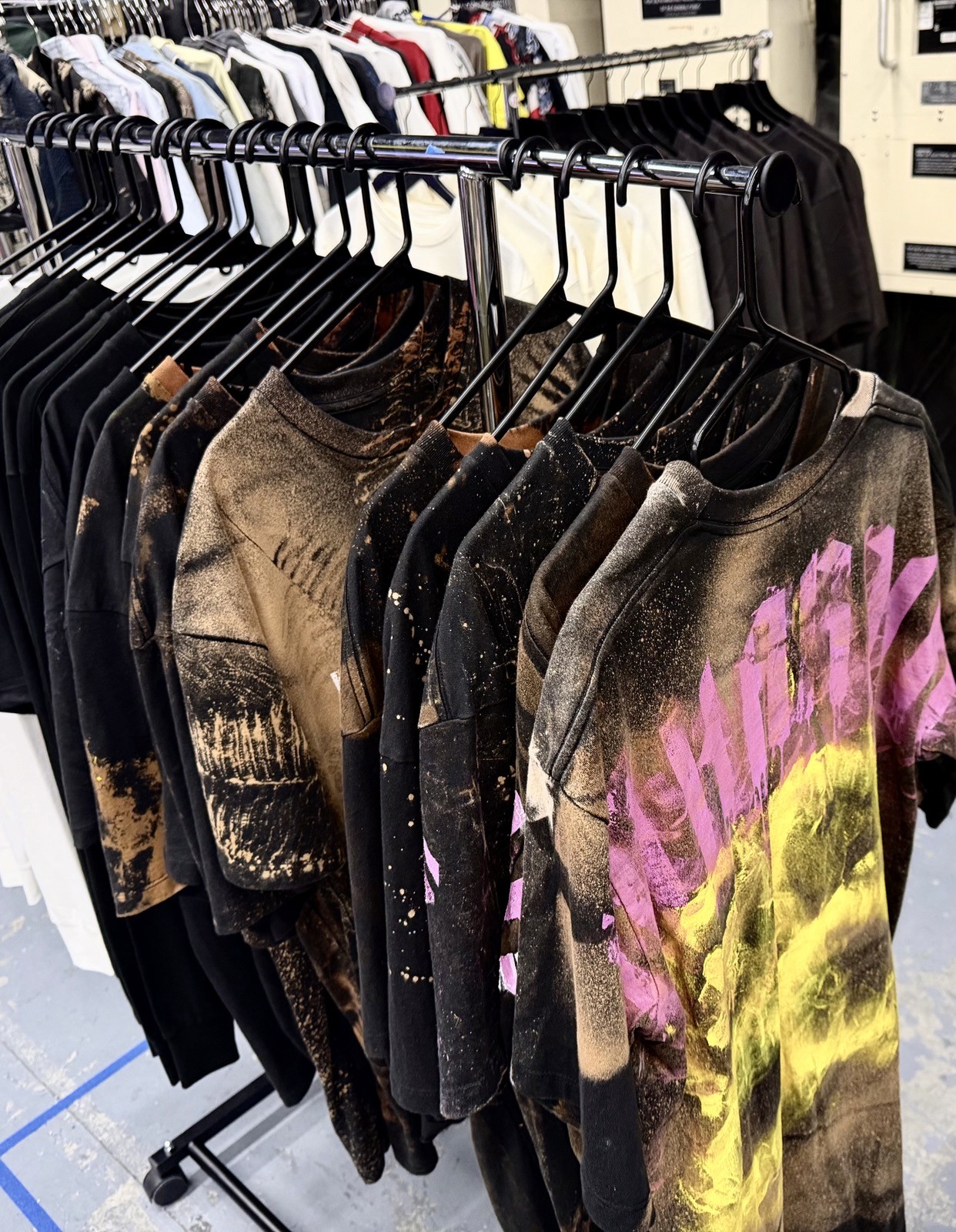
If you've ever seen one of our shirts in person, you already know there's something about them that doesn't look like anything else out there. The colors bleed in ways that feel almost accidental. The contrast is raw. The bleach pattern underneath the screen printed graphic has a life to it that you can't fake with a digital print or replicate in a factory.
That's because we don't replicate them. Every single shirt we make is a one of one, meaning no two are identical, and once it's gone, it's gone. Here's the full story of how that actually works.
Why Bleach Dye?
We landed on bleach dyeing because we were frustrated with how most custom shirts look. Either they're too clean, too uniform, or they look like merch. We wanted something that felt more like a piece — something with texture and history baked into the fabric before the design even touches it.
Bleach dyeing strips color from the fabric in unpredictable ways. Depending on how concentrated the bleach solution is, how long it sits, what the original garment color is, and how you apply it, you can get anything from a subtle sun-faded wash to high-contrast explosive bursts of orange, yellow, and cream. No two applications are ever the same, which means no two shirts ever come out the same.
That unpredictability is the point.
The Shirts We Start With
Not all garments bleach the same way. Cotton content, dye type, and fabric weight all affect the final result. We've tested a lot of blanks to figure out what actually works.
100% cotton garments react most dramatically and consistently. The bleach hits fast, lifts deep, and gives you the best color range, usually moving from the base color through a warm orange or golden tone before hitting cream or white at the center of the bleach zone.
50/50 blends bleach more slowly and often land at a lighter, more washed-out version of the original color rather than going fully warm. The result is softer, more subtle, which works great for certain aesthetics.
Polyester-heavy fabrics mostly resist bleach altogether, which is why we stay away from them for this process.
We primarily work with heavyweight 100% cotton tees because the fabric holds the bleach pattern with more definition, and they wear and wash better over time.
The Bleach Dye Process, Step by Step
This is where experimentation lives. Even now, after making hundreds of shirts, every batch involves some adjustment. Here's how our current process works:
Preparing the Bleach Solution
The ratio of bleach to water is everything. Too strong and the shirt degrades quickly — you'll feel it go thin and brittle over time. Too weak and the color barely lifts, leaving you with something muddy rather than striking.
We've landed on roughly a 1:1 to 2:1 water-to-bleach ratio depending on the color of the starting garment and how dramatic we want the result. Darker starting colors need a stronger mix to lift effectively. We always mix in a spray bottle or bowl right before use — bleach loses potency fast once it's diluted.Applying the Bleach
This is where the design decisions happen. There are several techniques we rotate through depending on the look we're after:
Spray application gives the most organic, unpredictable pattern. Holding the bottle further away creates a wide mist. Getting close creates concentrated spots. Layering passes while the shirt is crumpled or bunched creates a texture that's impossible to plan.
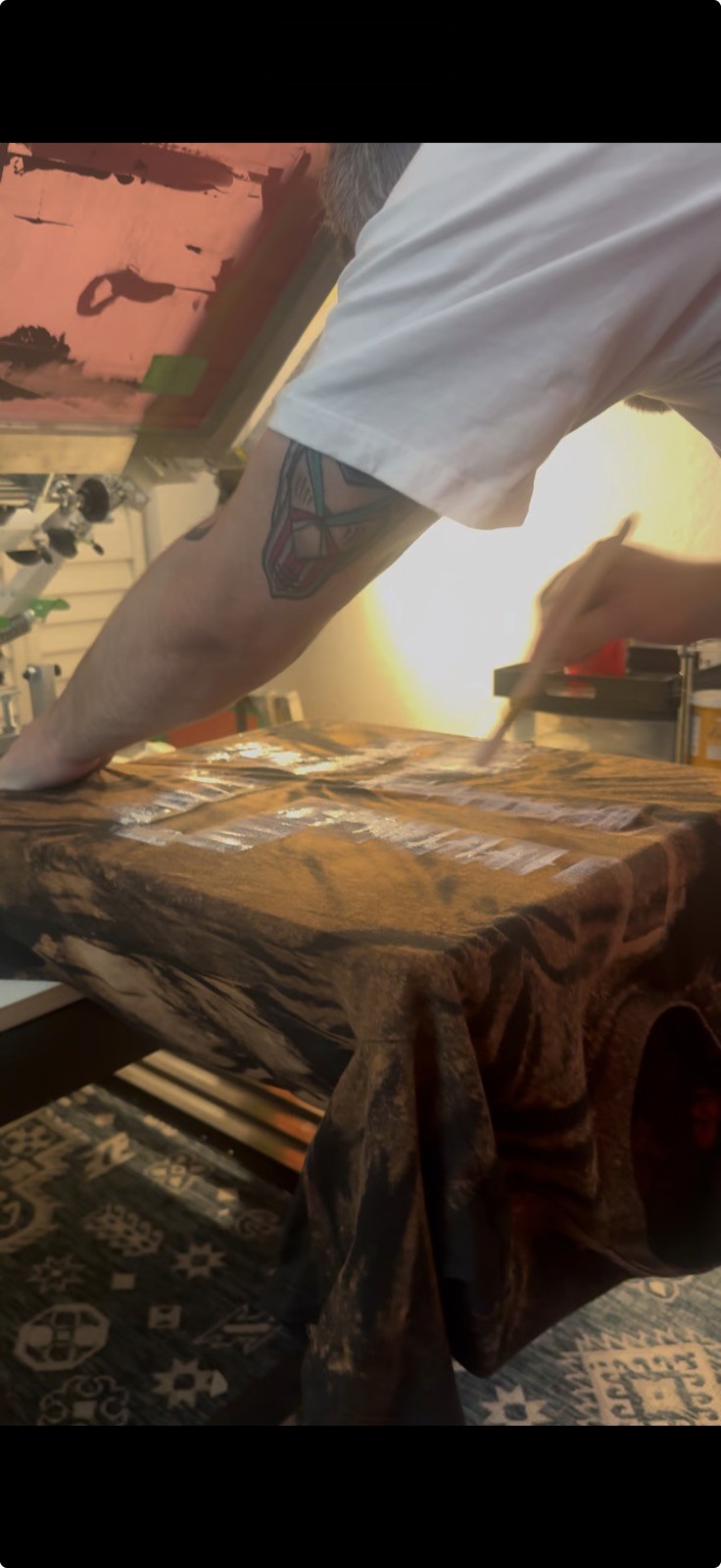
Scrunch and dip involves twisting or scrunching sections of the shirt and partially submerging them in the bleach solution. Where the fabric is compressed, the bleach creeps in slowly. Where it's exposed, it hits fast. The result is a kind of organic starburst pattern that has depth to it.Spot bleaching means applying bleach directly to specific areas with a brush, sponge, or dropper. We use this when we want to frame a particular zone of the shirt, like clearing out the chest area where a screen print will sit, while leaving the sleeves or hem in their original color.
Ice bleaching is one of our favorites for summer pieces. We place ice cubes over the fabric on a rack, then pour undiluted bleach over the ice. As the ice melts, it disperses the bleach slowly and unevenly, creating soft-edged pools of color that look completely different from spray or dip methods.
Letting It React
Reaction time varies a lot. We watch the shirt rather than watching a clock. Color lifting tends to plateau, it moves fast in the first few minutes, then slows. We pull the shirt once we see the tones we're after, usually somewhere between 5 and 25 minutes depending on fabric, solution strength, and technique.
Temperature matters too. Bleach works faster in warm conditions. We've had shirts over-bleach on hot days when we weren't paying attention, and under-bleach in cold weather with the same exact solution.Neutralizing and Washing
Once we hit the look we want, the shirt goes straight into a neutralizing rinse — either hydrogen peroxide diluted in water, or a thorough cold water rinse followed by a wash with a bit of baking soda. This stops the bleach from continuing to eat into the fibers, which it will do if you don't neutralize.
After neutralizing, we run a standard warm wash and let the shirt air dry. The final color reveals itself fully once dry, there's always a bit of a reveal moment here, because wet bleached fabric looks different than dry.
The Screen Printing Layer
Once the bleach-dyed base is ready and dry, it goes into the screen printing process. This is the other half of what makes these shirts what they are.
Screen printing onto a bleach-dyed base is different from printing onto a plain blank. The surface isn't uniform, the bleach has created a gradient, a texture, a color story underneath. That means the printed design has to work with the base, not just sit on top of it like it was printed on a white tee.
We design with this in mind. A lot of our graphics use bold, high-contrast ink that reads clearly regardless of where on the bleach gradient it lands. We lean into white and off-white inks, which pop dramatically against both the bleached zones and the darker original fabric areas.
Because each shirt has a different bleach pattern, every print lands slightly differently, the same design might sit in the center of a bleach burst on one shirt, and overlap the edge of it on another. That variation is something we've come to embrace. It's what makes each shirt genuinely unique.
Ink and Opacity
We use plastisol ink for most of our screen prints because it sits on top of the fabric with full opacity, it doesn't get affected by the underlying bleach tone in the way that water-based inks can. That said, we do experiment with water-based inks on certain designs where we want a softer, more worn-in print that lets the fabric texture show through.
For one of one designs, we sometimes do individual hand-pulled prints rather than production runs, which lets us adjust pressure and ink loading shirt by shirt based on exactly how the bleach pattern turned out.
What Makes a One of One
The "one of one" label gets thrown around a lot. For us it has a specific meaning: no two shirts in our catalog share the same exact bleach pattern, and we don't attempt to recreate specific results. When a shirt is sold, that exact combination of bleach design and screen print is retired.
We photograph and catalog every shirt before it goes up for sale, which means what you see in the listing is what you're actually buying, not a representative example of a style, but the specific object itself.
This comes with tradeoffs. It's slower. You can't restock. If someone misses a drop and the shirt sells out, it's gone. But it also means everything we put out has a singularity to it that mass production can't touch.
What We've Learned from Experimentation
Honestly? Most of what we know came from ruining shirts.
Early on we went too heavy with the bleach concentration and ended up with a batch that felt like tissue paper after a few washes. We've had shirts where the bleach crept into areas we didn't intend, and others where the neutralization was off and the fabric continued degrading after the fact.
Some things we figured out the hard way:
Don't rush the neutralization. Leaving a shirt even a few minutes too long in un-neutralized bleach after you've hit your target can visibly change the final result.
The base garment color determines your ceiling. You can't bleach black to white in one pass with a safe concentration. Dark charcoals will land in the rust-to-tan range. Navy often produces beautiful coral and sandy tones. Knowing your destination color means knowing your starting point.
Humidity affects everything. Working in a humid environment slows the reaction and can create softer edges. Dry conditions speed it up and tend to create more defined zones.
Every bleach brand is different. Generic store-brand bleach often has a lower sodium hypochlorite percentage than name brands, which changes how fast and how dramatically it lifts. We test each new supply before running a full batch.
The Bigger Idea
We're not the first people to bleach dye shirts, and we're not trying to claim we invented anything. What we are doing is taking a process that's inherently unpredictable and leaning into that rather than trying to engineer it out.
Most apparel production is about eliminating variation. Every unit should look the same. Every run should be consistent. We've built something that works in the opposite direction, where the variation is the product, and the process itself is part of what you're buying into.
If you've got one of our shirts, there's literally no one else in the world with that exact shirt. That's not hype. That's just what happens when you let bleach do what bleach does.
Want to see the latest one of ones? Check our drop page, everything is photographed individually and quantities are always limited.